
Insights · AI
What Happens to Your Skills When AI Does the Work?
Expert doctors found fewer warning signs on their own after three months of AI help. Pilots learned the fix years ago.
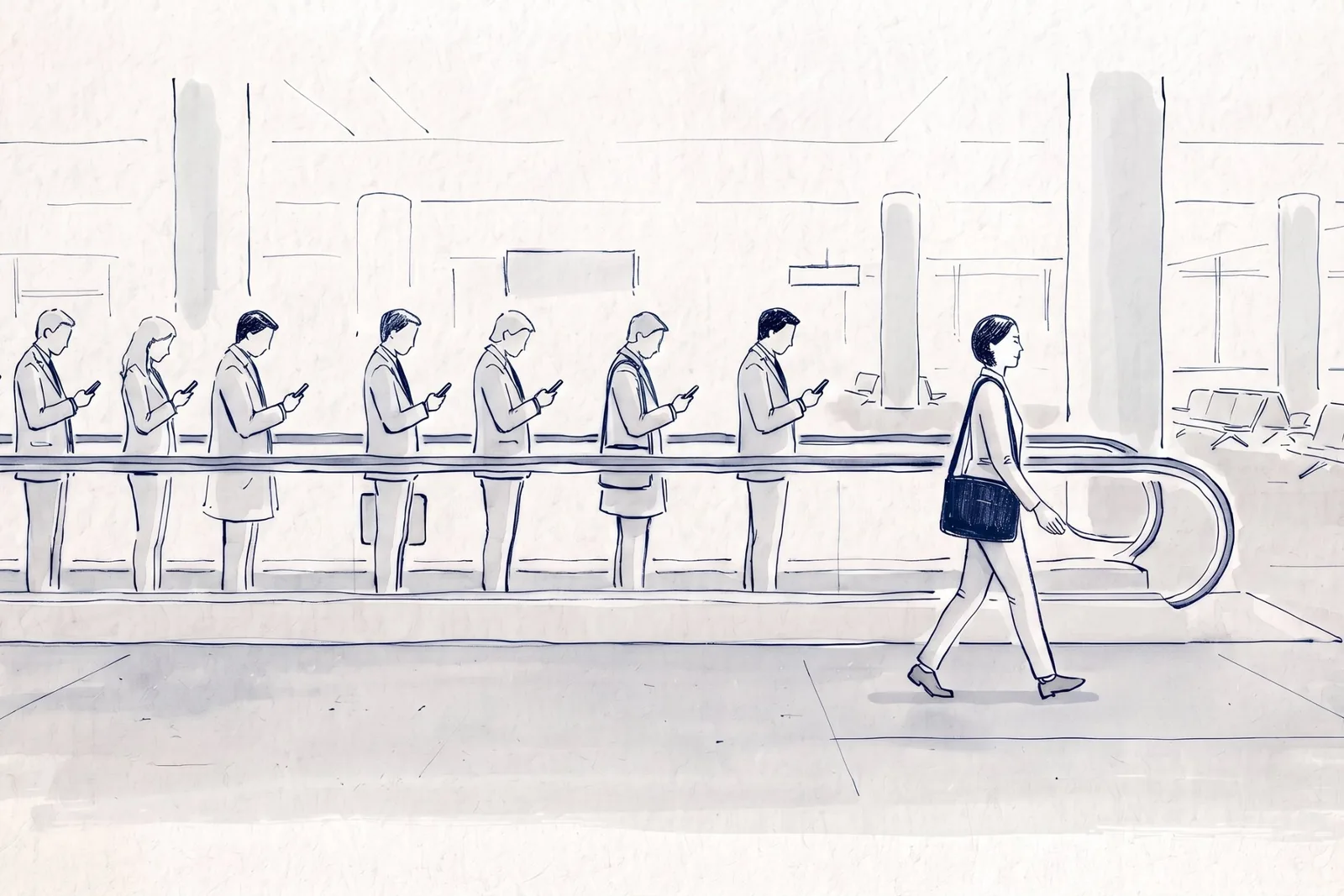
You hand a task to AI, it does the job well, and you stop doing that job yourself. That's the point of the tool. But a 2025 study of experienced doctors suggests the handoff can cost you something you won't notice until the AI is switched off.
Nineteen endoscopists in Poland, each with more than 2,000 colonoscopies behind them, began using an AI tool that boxes possible precancerous growths during the exam. Three months later, on exams done without it, they found those growths in 22.4% of colonoscopies, down from 28.4% before the AI arrived (Budzyń et al., Lancet Gastroenterology & Hepatology). That's a 20% relative drop, from doctors who were anything but beginners.
The lesson isn't to stop using AI. Airline pilots worked out the better answer more than a decade ago. Use it like autopilot, not like a crutch.
What happened to the doctors' skills?
Their detection rate without AI fell six percentage points in three months. In a colonoscopy the doctor's eyes scan every fold for growths that are easy to miss, and with AI on, the box does much of that looking. The researchers' worry is deskilling: when a machine does the work long enough, the skill behind it fades. One gastroenterologist called it "the quiet erosion of fundamental skills" (The Lancet).
It's one observational study. The centers' workload nearly doubled after the AI arrived (Science Media Centre Spain), and other studies in Japan and Norway found no drop (Okumura et al., Endoscopy; Pedersen et al., Endoscopy). Treat it as a warning, not a verdict. Aviation already has the verdict.
Where have we seen this before?
In the cockpit. In 2013 the FAA issued a safety alert after flight data "identified an increase in manual handling errors" (FAA SAFO 13002). Autopilot had made flying safer, but pilots who rarely flew by hand were getting rusty. The FAA didn't switch the autopilot off. It told airlines to let pilots fly by hand regularly, and a 2017 follow up wrote manual flying into every training curriculum (FAA SAFO 17007).
That's the difference between autopilot and a crutch. You lean on a crutch because you can't walk without it. You use autopilot because you can fly, and you choose to let the machine take part of the trip.
What does the research say beyond medicine?
It's mixed on doctors, clear on pilots, and consistent for office work: the more you trust the tool, the less you check it.
| Who | What researchers found | Source |
|---|---|---|
| 19 experienced endoscopists, Poland | Detection without AI fell from 28.4% to 22.4% after three months with AI | Budzyń et al., Lancet Gastroenterology & Hepatology, 2025 |
| 13 endoscopists, Norway | No drop, and no gain, after the AI was taken away | Pedersen et al., Endoscopy, 2026 |
| One hospital, Japan, 4,712 matched patients | Detection without AI held steady over three years | Okumura et al., Endoscopy, 2025 |
| Airline pilots, United States | Manual handling errors rose; airlines told to schedule hand flying | FAA SAFO 13002, 2013 |
| 319 knowledge workers, 936 real examples | More confidence in AI went with less critical thinking | Lee et al., Microsoft Research and Carnegie Mellon, 2025 |
When I put this to work
When I train a team on AI, the first conversation isn't about tools. It's about the Why, seen through the four lenses of the Rings of Reflection: who you are, what you've built, who's here and who's next. From there we build a curriculum around what needs to be built, where it fits in the business, and how we'll measure whether it's working.
As the team crawls, walks and then runs with its AI tools, there's an intentional human step built into the work, for now. That step makes sure the years of experience inside the business aren't forgotten or ignored. The AI takes on the tasks that carry little human value, and the owner and staff get their time back for the human side of the business.
I also give every team tools and strategies for staying in the loop while AI works alongside them. That keeps your brain on the things that matter, while the AI handles the work where it adds value.
How do you stay in the loop while AI does the work?
Keep a deliberate human step in the work, and practice without the tool. Six of the strategies I give teams:
- Split the work by human value. Hand over the reminders, follow ups, formatting and first drafts. Keep your hands on the judgment and relationships customers pay you for, with AI assisting.
- Think first, then ask. In a small MIT Media Lab study, not yet peer reviewed, people who wrote on their own first and then switched to ChatGPT showed higher recall and broader brain engagement than people who went the other way (Kosmyna et al., MIT Media Lab).
- Make it a thinking partner. Argue with it: ask for the strongest case against your plan before you commit. Brainstorm with it, then pick and shape the few ideas worth keeping yourself. And let it interview you before it writes anything, so the thinking and the experience stay yours.
- Fly by hand on purpose. Do some low stakes work without AI, the way pilots hand fly when the workload is light. One proposal a month, one analysis a quarter.
- Check it every time it matters. Microsoft and Carnegie Mellon found "higher confidence in GenAI is associated with less critical thinking" (Lee et al., Microsoft Research and Carnegie Mellon). If you can't explain why the answer is right, you aren't done.
- Measure yourself without it. The Polish slip only showed up because someone measured the doctors without AI. Spot check your team's work without the tool, so you see a slide before a customer does.
The exact prompts, and how they fit into a team's week, are what I build with each client.
Let AI fly most of the trip. Keep your hands good enough to land the plane.
Read the full article
What did the colonoscopy study actually measure?
It measured the adenoma detection rate, or ADR: the share of colonoscopies in which the doctor finds at least one adenoma, a growth that can turn into colorectal cancer. It is not an accuracy score. It matters because doctors with higher ADRs leave their patients at lower risk of dying from colorectal cancer later (Dominitz et al., Gastroenterology).
The study ran from September 2021 to March 2022 at four centers in Poland taking part in the ACCEPT trial. After the centers added AI at the end of 2021, each exam was done with or without AI depending on the date, assigned at random. The researchers compared exams done without AI in the three months before the tool arrived (795 exams) with exams done without AI in the three months after (648 exams). The doctors were gastroenterologists and surgeons performing live camera exams, not radiologists reading scans (Budzyń et al., Lancet Gastroenterology & Hepatology).
One more number worth knowing: with the AI switched on, the same doctors found adenomas in 25.3% of exams (186 of 734). That's above their 22.4% without AI, but below their own 28.4% from before the AI arrived (The Lancet).
Why do other experts urge caution?
The study's authors say themselves that an observational design leaves room for other explanations, and that results from experienced doctors may not hold for everyone (The Lancet). Outside experts added more.
- Workload. The number of colonoscopies in the study went from 795 in the three months before the AI to 1,382 in the three months after (648 without AI plus 734 with it). Professor Venet Osmani of Queen Mary University of London pointed out that a heavier, more tiring schedule could lower detection on its own (Science Media Centre Spain).
- Other changes. Major changes were made to the endoscopy departments during the study, it tested a single AI system, and randomized crossover trials are needed for firmer claims (Science Media Centre).
- Other studies. A single hospital study in Japan put AI in half its rooms and followed 4,712 matched patients from January 2021 to December 2023. Detection without AI "was maintained and did not decline over time" (Okumura et al., Endoscopy). A Norwegian trial had 13 endoscopists perform 5,013 colonoscopies across three phases: before AI, with AI, then with the AI taken away. It found no deskilling and no upskilling without AI, though AI temporarily raised detection for the less experienced doctors (Pedersen et al., Endoscopy).
- Scale. The largest study so far, across 816 endoscopists at 139 US Veterans Health Administration facilities, found detection rose from 50.7% to 54.9% at sites given AI, while control sites slipped from 51.8% to 51.1%. Its authors called the deskilling question "undetermined" (Dominitz et al., Gastroenterology).
The honest read: AI helps doctors find more growths while it's on. Whether leaning on it wears down the skill underneath is still an open question, and the Polish study is the strongest signal so far that it can.
What's the difference between deskilling and automation bias?
Deskilling is losing a skill because a machine has done the work for long enough. Automation bias is going along with the machine even when your own judgment disagrees. Professor Allan Tucker of Brunel University of London said the Polish study highlights the second risk, and noted that a doctor who overrules an AI may later have to defend that call, which makes agreeing feel safer (Science Media Centre Spain).
At work, both show up. The first is losing the skill. The second is not using the skill you still have.
What did aviation change?
The FAA's 2013 alert credited autopilot with better safety and workload management, and warned that constant use doesn't keep manual skills sharp (FAA SAFO 13002). Its 2017 follow up went further: every training curriculum should include training and a proficiency check on manual flight (FAA SAFO 17007). In 2016 the US Department of Transportation's Inspector General found the FAA still had no process to make sure airline pilots kept their manual flying skills while relying on automation (US DOT Inspector General).
The parallel for a business is direct. The fix was never less automation. It was deliberate practice without it, written into how the work runs.
FAQ
Does using AI make people worse at their jobs?
It can, for skills they stop practicing. A 2025 study found expert doctors detected fewer precancerous growths without AI after three months of using it, though two other studies found no such drop. Aviation has documented the same pattern with autopilot.
Should my team stop using AI to protect their skills?
No. Pilots didn't stop using autopilot. The FAA asked airlines to schedule regular time flying by hand. Keep using AI, and build in practice without it on the work that matters most.
What should I hand to AI first?
Chores: reminders, follow ups, research, formatting and first drafts. Keep the judgment your customers pay for in human hands, with AI assisting rather than deciding.
How can I tell if my team leans on AI too much?
Check their work without the tool now and then. If quality drops when AI is off, or nobody can explain why an AI answer is right, the skill underneath is slipping.
How do you stay in the loop when using AI?
Build a deliberate human step into AI assisted work, think before you prompt, argue with it and let it interview you, check the output whenever it matters, and practice the work without AI now and then. Pilots do the same with autopilot: they still fly by hand on purpose.
- Krzysztof Budzyń, Marcin Romańczyk, Diana Kitala et al., Endoscopist deskilling risk after exposure to artificial intelligence in colonoscopy: a multicentre, observational study, The Lancet Gastroenterology & Hepatology 10(10), 896 to 903 (2025)
- The Lancet, Routine AI assistance may lead to loss of skills in health professionals who perform colonoscopies, study suggests, press release via EurekAlert (2025)
- Science Media Centre, Expert reaction to observational study looking at detection rate of precancerous growths in colonoscopies (2025)
- Science Media Centre Spain, The use of AI may lead to a loss of skills among those who perform colonoscopies, expert reaction from Venet Osmani (2025)
- Science Media Centre Spain, expert reaction from Allan Tucker, Brunel University of London (2025)
- Takuya Okumura, Shin-ei Kudo et al., Long-term impact of computer-aided adenoma detection: a prospective observational study, Endoscopy 58(2), 121 to 129 (2026; online July 2025)
- Tor Arne Pedersen, Yuichi Mori, Edoardo Botteri et al., Learning and deskilling effects of artificial intelligence in colonoscopy among endoscopists with different levels of experience: a pragmatic, prospective trial, Endoscopy 58(9), 1003 to 1014 (2026)
- Jason A. Dominitz, Andrew J. Gawron, Grace B. McKee, Katherine J. Hoggatt and Tonya Kaltenbach, Impact of Availability of Computer-Aided Detection Devices on Adenoma Detection During Colonoscopy: A Cluster Randomized Study, Gastroenterology 171(5), 870 to 884 (2026)
- Federal Aviation Administration, SAFO 13002, Manual Flight Operations (January 4, 2013)
- Federal Aviation Administration, SAFO 17007, Manual Flight Operations Proficiency (May 4, 2017)
- US Department of Transportation, Office of Inspector General, Enhanced FAA Oversight Could Reduce Hazards Associated With Increased Use of Flight Deck Automation (January 2016, archived copy)
- Hao-Ping Lee, Advait Sarkar, Lev Tankelevitch, Ian Drosos, Sean Rintel, Richard Banks and Nicholas Wilson, The Impact of Generative AI on Critical Thinking: Self-Reported Reductions in Cognitive Effort and Confidence Effects From a Survey of Knowledge Workers, CHI 2025
- Nataliya Kosmyna et al., Your Brain on ChatGPT: Accumulation of Cognitive Debt when Using an AI Assistant for Essay Writing Task, arXiv preprint 2506.08872 (2025)