
Insights · Customer Loyalty
The Car Wash Experiment That Explains Customer Loyalty
A free head start nearly doubled how many customers finished a loyalty card. What it means for keeping customers instead of renting them.
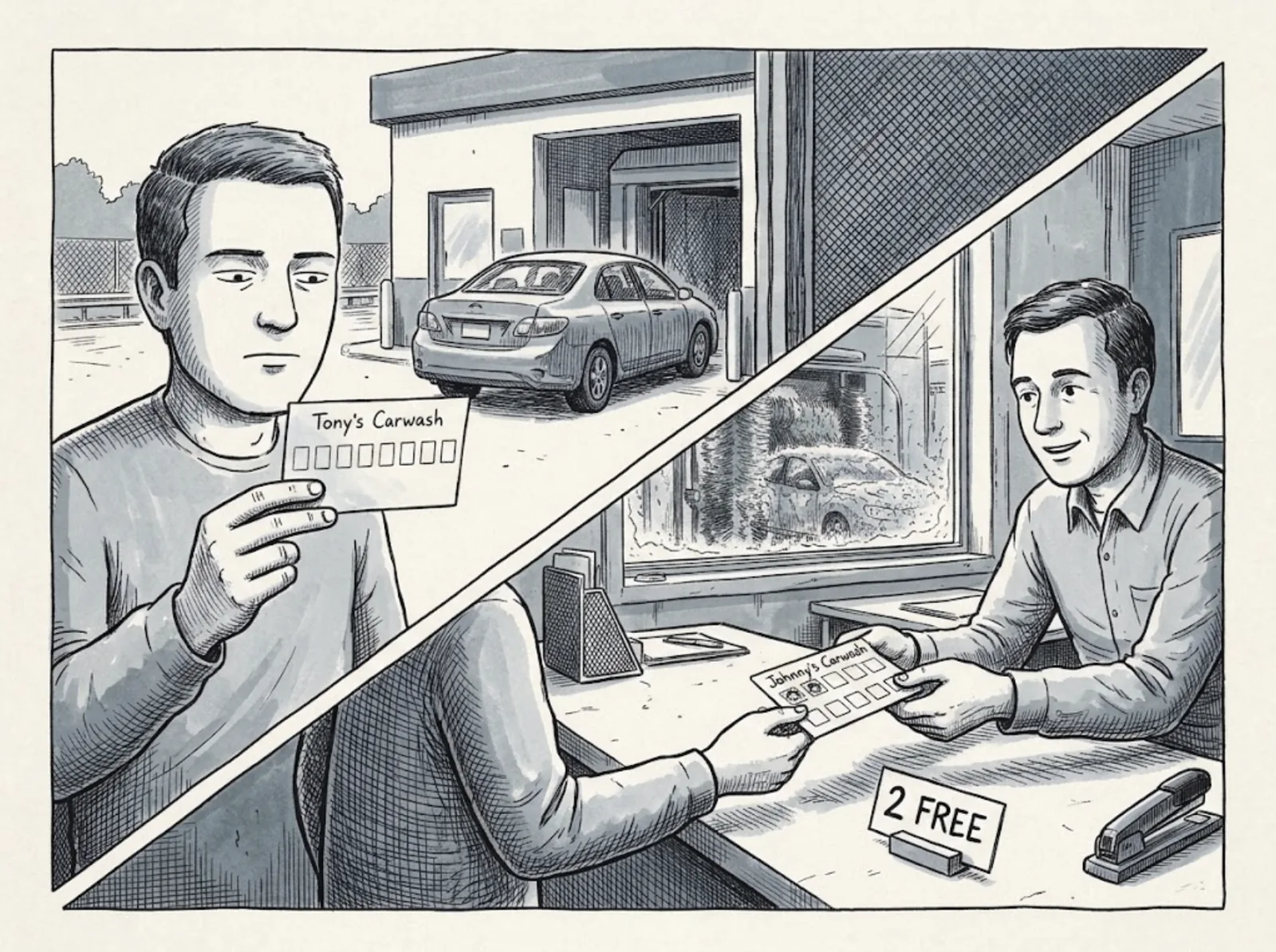
Picture two punch cards from the same car wash. Both earn you a free wash after eight paid ones. One is blank, with eight boxes. The other has ten boxes, but the first two are already punched. Same price, same reward, same eight washes. Which card do you think customers finish?
Researchers Joseph Nunes and Xavier Drèze ran this exact test, and the head start card won by a wide margin. It is the clearest lesson I know on how to build customer loyalty, and it shaped how I use customer data.
What happened in the car wash experiment?
Nunes and Drèze handed out 300 loyalty cards at a car wash and tracked customers for nine months (Silicon Canals). Each customer got one of two cards. Either way, they needed eight paid washes to earn the free one. The only difference was how the card looked on day one.
Of the customers with the blank card, 19% earned the free wash. Of the customers with the head start card, 34% did. That is about 79% more customers finishing, with no change to the deal.
| Car wash loyalty card | Earned the free wash | Source |
|---|---|---|
| Blank card: 8 boxes, 8 washes to earn the free one | 19% | Silicon Canals |
| Head start card: 10 boxes, 2 already punched, 8 washes to earn the free one | 34% | Silicon Canals |
The same pattern shows up with coffee. In a separate study, customers handed a 12 stamp card with two bonus stamps finished in 12.7 days on average, versus 15.6 days for a plain 10 stamp card (Chicago Booth Review). Ten purchases either way.
Why does a head start build loyalty?
Because people feel the journey, they don't count the work. The first customer sees a long road. The second sees a card that is already 20% done. Psychologists call this the endowed progress effect: give someone a sense that they have already started and they are more likely to finish. The coffee card research adds a second effect. Customers buy more often as the reward gets closer (Columbia Business School).
When I put this to work with data
I spent years using data science to understand how customers actually behave: how often they buy, how long between visits, and the moment they go quiet. Then I acted on it with in app notifications, and purchases went up 28%.
The lift came from three habits working together. Hyper targeting, so each customer heard from us at a moment that fit where they were. A/B testing on the message, because wording that works for one segment flops with another. And testing time of day, because the same notification can perform very differently at 8 a.m. and at 8 p.m. A customer two visits from a reward who has gone quiet needs a reminder that they are close. A brand new customer needs to feel they have already started. It is the car wash card, translated into software.
Are deal hunters the same as loyal customers?
No, and mixing them up is expensive. A discount can bring someone through the door. It can't make them stay. In one 2026 survey, only 5% of shoppers said they would stay loyal at full price if a competitor offered 20% off, and 44% said they had dropped a brand they liked once its discounts disappeared (CouponFollow). A 2010 conference study found that rebate use was negatively related to loyalty measures, and warned that brands can convert loyal customers into deal seekers (Georgia Southern). The survey comes from a coupon company, so read it with that in mind, but its direction matches the academic work.
If your program runs on discounts alone, you aren't building a sticky customer base. You're building a deal hunter base.
How do you build loyalty that sticks?
- Give a head start. Start every new customer partway to a reward.
- Show progress. Make the distance to the reward visible at every touch.
- Segment by behavior. Separate deal hunters from repeat customers and treat them differently.
- Nudge at the moment of drift. Use data to find when customers go quiet, then send something relevant.
- Test everything. Message, audience and send time.
Make customers feel valued from the first visit, and the next discount has less to compete with.
Read the full article
What is the endowed progress effect?
The endowed progress effect is the tendency for people to work harder toward a goal when they are given artificial progress at the start. Nunes and Drèze named it after their 2006 car wash field experiment in the Journal of Consumer Research. The approach is to hold the purchases required and the reward constant, and change only how far along the card looks.
What did the coffee card study add?
Ran Kivetz, Oleg Urminsky and Yuhuang Zheng compared a 12 stamp coffee card with two bonus stamps against a plain 10 stamp card. Both needed ten purchases. Customers with the bonus stamps finished in 12.7 days on average versus 15.6 days (Chicago Booth Review). They also found that customers speed up as they near a reward, and that people who completed one card slowed down right after redeeming, when the next reward felt far away.
What should you measure besides redemption?
Completion shows someone reached a threshold. It does not show what happened next. Track time between visits, return after the reward, total purchases and reward cost, so a program that looks successful on one number does not quietly lose money on another.
FAQ
What is the endowed progress effect?
It is the tendency for people to work harder toward a goal when they are given a sense of artificial progress at the start. Nunes and Drèze named it after their car wash experiment.
Do loyalty programs really work?
They can, but design matters. In the car wash study, 34% of customers with a pre punched card earned the reward versus 19% with a blank card, even though both needed the same number of paid washes.
How do you identify deal seekers in your customer base?
Look at behavior. Deal seekers tend to purchase mainly when an offer is active, respond to discount messages far more than other messages, and lapse quickly when offers stop.
Are in app notifications effective for retention?
They are most effective when targeted to a customer's own behavior rather than sent as a generic broadcast. In the author's work, hyper targeting combined with A/B tests on message and time of day increased purchases by 28%. Results vary by business, so test in your own customer base.
Is a free head start the same as a discount?
No. A head start is progress toward a reward. A discount is a lower price. One builds momentum, the other can train customers to wait for the next sale.
- Nunes, J. C. and Drèze, X. (2006). The Endowed Progress Effect: How Artificial Advancement Increases Effort. Journal of Consumer Research, 32(4), 504 to 512. Field experiment summary: Silicon Canals
- Kivetz, R., Urminsky, O. and Zheng, Y. (2006). The Goal Gradient Hypothesis Resurrected. Journal of Marketing Research, 43(1), 39 to 58. Summaries: Columbia Business School and Chicago Booth Review
- CouponFollow, Why Discounts Matter More Than Brand Loyalty in 2026
- Academy of Marketing Science conference proceedings (2010), rebate proneness and loyalty