
Insights · Leadership
You Can't Talk Your Way Out of a Bad Habit
Stephen Covey said it about trust. It's just as true of the habits that run you and your business, and the way out is the same: new behavior, repeated until it sticks.
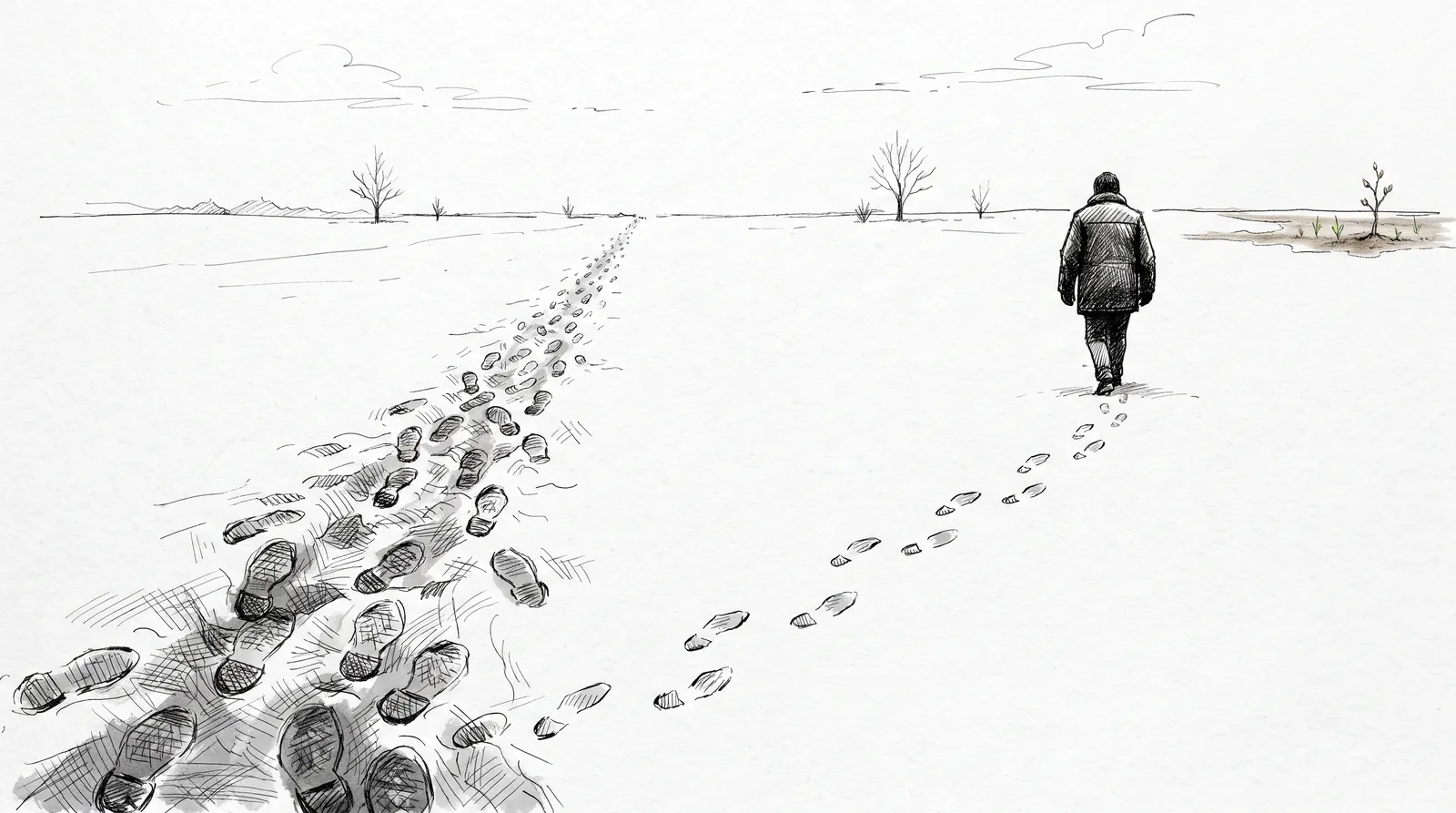
A man at one of Stephen Covey's seminars wanted a quick fix. His wife no longer trusted him, and he wanted her to change. Covey's answer is one of the best known lines in The 7 Habits of Highly Effective People:
“You can't talk your way out of problems you behave yourself into.”Stephen R. Covey, The 7 Habits of Highly Effective People
Covey was talking about trust. The line fits habits just as well. Nobody decides to check email at dinner, sign off on every purchase, or finish the team's sentences in meetings. Those habits were behaved into, one repetition at a time. A resolution won't undo them. A new behavior, repeated, will.
Why can't you talk yourself out of a bad habit?
Because most of what you do each day never passes through a decision. In a 2025 study that checked in with people six times a day for a week, about 65% of what they were doing had been started by habit, not by choice (Rebar et al., Psychology & Health). Habits fire on cues: a time, a place, a person, a feeling. Your good intentions aren't in that loop.
That's why intentions leak. Across 22 studies and nearly 30,000 people, almost half of those who intended to be active didn't follow through (British Journal of Sports Medicine, 2023). Wanting to change is necessary. It just isn't enough.
Why does a bad habit hang on after it stops working?
Because every habit was a solution once. The late nights built the business. Answering every question yourself kept customers happy when there were five of them. Then the reason left, and the habit kept running.
The research points the same way. A 2023 study of gym and hospital data found that people with an established habit responded less to new rewards (Buyalskaya et al., PNAS). Once a behavior is on autopilot, it stops checking whether it still pays.
So before you fight a habit, ask what it did for you. That's the Why at the center of the first lens in my Rings of Reflection, Who you are. Name the need, and you can meet it a better way.
What does the research say about breaking habits?
| Finding | What it means for you | Source |
|---|---|---|
| About 65% of daily behaviors are started by habit, not a decision | Change has to happen at the cue, not only in your head | Rebar et al., Psychology & Health, 2025 |
| Almost half of people who intend to exercise don't follow through (47.6%) | An intention is a start, not a plan | British Journal of Sports Medicine, review of 22 studies, 2023 |
| New habits took a median of 59 to 66 days to form, from 4 to 335 days for individuals | Plan for months, not 21 days | Singh et al., Healthcare, 2024 |
| Habits people chose for themselves, and morning habits, grew stronger | Let people pick their own new routines | Singh et al., Healthcare, 2024 |
| If then plans worked better when written as if then, when people were motivated, and when the plan was rehearsed | Write the cue and the new response down, then practice it | Sheeran, Listrom and Gollwitzer, 642 tests, 2024 |
| Managers account for 70% of the variance in team engagement | What you model shapes how your team works | Gallup |
What does trust have to do with it?
Covey's seminar guest needed his wife to trust him again. Breaking a habit takes three kinds of trust, and all three are built the same way: by behavior, repeated.
Trust in yourself grows each time you keep a small promise. Start small enough that you can't miss.
Trust from your team comes from seeing the new behavior, not hearing about it. Tell them what you're changing, then let them watch you do it.
Trust in the process means giving it months, with checkpoints along the way, instead of judging it on day ten.
When I put this to work
The habit I see most often belongs to the owner. "I want my life back," they tell me. Usually that means every decision still runs through them, and they don't see it yet. Change sounds easy until they're the one who has to change. And they remember when it worked: when they ran it, it was so successful.
It did work. It was a different time, with 10 to 15 hour days and an early team that would do anything. Then the business grew, hiring changed, and the habit stayed.
So we don't start with a pep talk. We start with Discovery: the owner, the leadership team and me, looking at how decisions really move. Then we build the new route and the guardrails around it: regular one to ones, a few people who have a good pulse of the team, and leadership meetings open enough that everyone knows the goals for the year and the quarter. Then we review and reassess, because the business keeps changing too.
How do you break a bad habit?
- Name the behavior, not the trait. "I approve every purchase over $50" is something you can change. "I'm a control freak" isn't.
- Ask what it does for you. Find the need underneath, because you'll have to meet it another way.
- Find the cue. For one week, note when and where the habit shows up, who's there and how you feel. Psychologist Benjamin Gardner recommends a habit diary for exactly this (The Independent).
- Write an if then plan for the replacement. "If someone brings me a decision under $500, then I'll ask what they'd do, and let them do it." Rehearse it once or twice before the moment comes.
- Change the room. Remove the cue where you can, and make the new behavior the easy one.
- Bring your team in. Tell them what you're changing and ask them to flag it when you slip. When the habit is theirs, let them choose the new routine.
- Set checkpoints, then keep going. A date, a milestone or a number. Expect months, and don't quit over one miss.
You behaved your way in. You can behave your way out.
Read the full article
Where does the line come from?
Covey tells the story in The 7 Habits of Highly Effective People (1989), where he argues for change from the inside out: character first, technique second. In retellings of the book, the seminar was on the Oregon coast, and the man wanted Covey to fix his wife's suspicion rather than his own behavior (A Learning a Day, Quick fix on the Oregon coast). Covey's point was that trust broken by behavior gets rebuilt by behavior. The line also circulates in other wordings, with "talk yourself out" in place of "talk your way out."
Why doesn't "just stop" work?
The researchers behind the 65% finding put it plainly: telling people to try harder isn't enough. Lasting change means disrupting the old cues and building a better habit in their place (University of Surrey, 2025). The same study found that most habits were in line with what people intended, which is the good news: once a better habit forms, it carries you.
If then plans help with the "in their place" part. Across 642 tests, they helped people steer their thoughts, feelings and actions, and the effects were larger when the plan used a clear if then format, people were highly motivated and the plan was rehearsed (Sheeran, Listrom and Gollwitzer). A plan can't supply motivation you don't have. If the goal isn't really yours, a sharper plan won't save it.
How long does it take to break a bad habit?
There's no magic number. The 21 day figure traces back to a 1960 self help book by a plastic surgeon, describing how long patients took to get used to a new appearance (Singh et al., 2024). In the studies that measured it, new habits took a median of 59 to 66 days, with individuals ranging from 4 to 335 days. Gym habits took months, while hospital handwashing took weeks (Buyalskaya et al., 2023). Simpler behaviors done more often tend to form faster.
What tools help?
- A habit diary. One week of notes on when, where, who and how you felt. Patterns show up fast.
- An if then card. One line, on your desk or your phone lock screen.
- Reminders you don't have to remember. Calendar nudges, or an AI assistant that handles reminders and follow ups, so your memory isn't the system.
- Friction. Put the old cue out of sight. Make the old behavior one step harder and the new one one step easier.
- A person. Someone on the team who will tell you, kindly and quickly, when you slip.
FAQ
How long does it take to break a bad habit?
Usually months, not weeks. Studies of new habits found a median of 59 to 66 days, with a range of 4 to 335 days, and simpler, more frequent behaviors form faster.
Can you break a habit with willpower alone?
Rarely. About 65% of daily behaviors are started by habit rather than a decision, so lasting change works on the cues and the replacement behavior, not on trying harder.
What's the best way to replace a bad habit?
Find the cue, then write an if then plan that names the new behavior: "If this happens, then I will do that." Plans work best when they're specific, rehearsed and tied to a goal you really want.
What if I slip?
Keep going. In a study of how habits form, missing one opportunity didn't significantly affect the process, though people who were very inconsistent didn't form habits.
How do I help my team change a habit?
Change your own first, where they can see it. Then let them choose their own new routines, since habits people pick for themselves tend to grow stronger, and set checkpoints you review together.
- Rebar, Vincent, Kovac Le Cornu and Gardner, Psychology & Health, 2025 (University of Surrey)
- British Journal of Sports Medicine, 2023
- Singh, Murphy, Maher and Smith, Healthcare, 2024
- Buyalskaya, Ho, Milkman, Li, Duckworth and Camerer, PNAS, 2023
- Sheeran, Listrom and Gollwitzer, European Review of Social Psychology, 2024
- Gallup, How managers impact team productivity
- The Independent, Running on autopilot, 2025
- UCL News, How long does it take to form a habit? (Lally et al.)
- A Learning a Day, Quick fix on the Oregon coast
- Stephen R. Covey, The 7 Habits of Highly Effective People, 1989