
XSL Consulting

Insights

People, Process, Technology and the Data Loop

A growing business rarely has one problem. It has a symptom in one place and a cause in another. This is the model I use to find which is which.
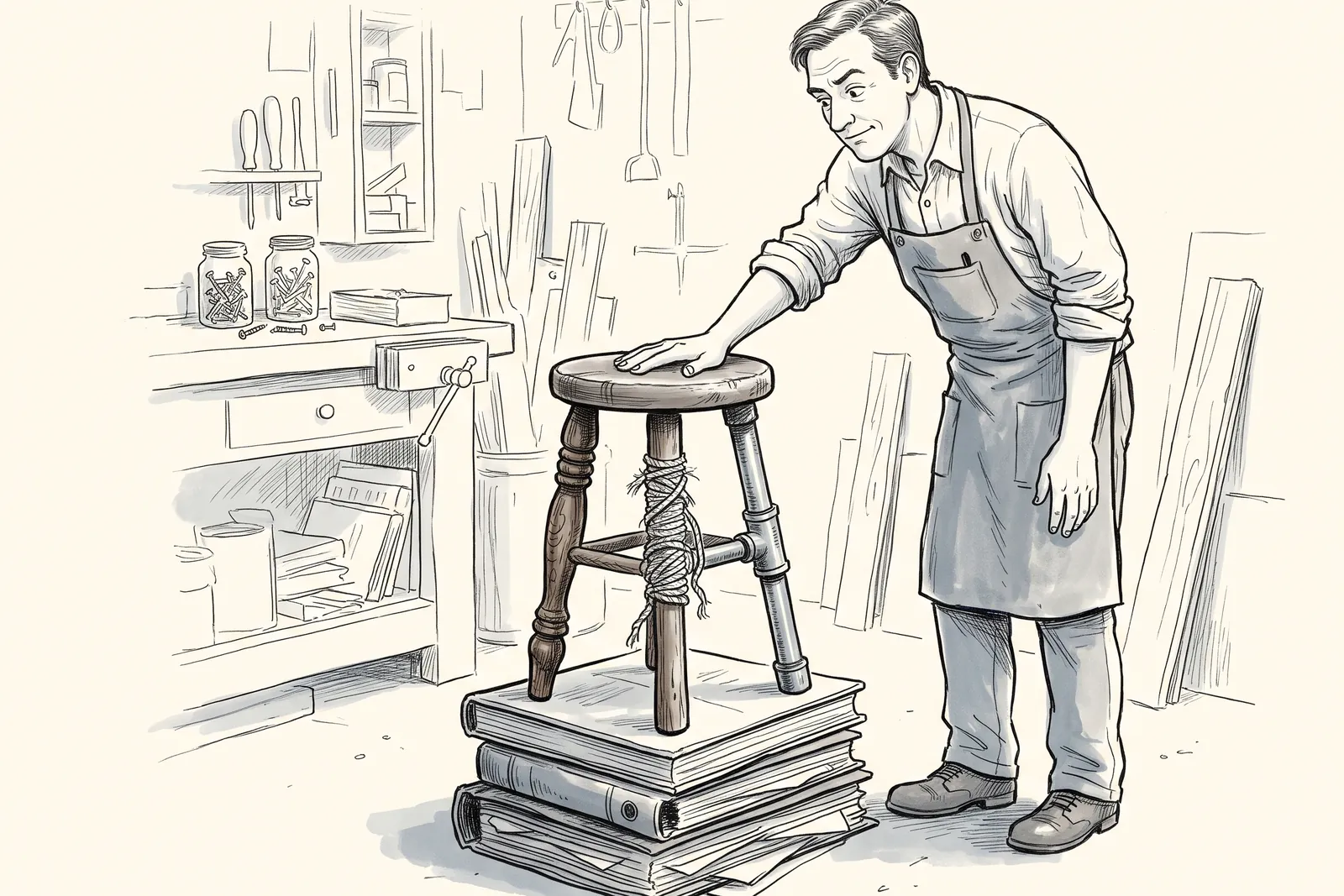
Ink drawing of a shop owner testing a three legged stool that stands on a stack of old ledgers
Three legs, one foundation. Test it before you sit down.

Why do so many fixes fail?

Most fixes in a growing business fail for one reason: they change one part and ignore the rest. A new tool gets bought, and nobody plans for the Process, the People or the Data it touches.

People, Process and Technology are connected, and Data runs under all three: it shapes how you decide on each, and keeping track of each is what keeps those decisions informed. In my experience the problem usually sits in one area, two, or all three, and very often in that loop.

Below: pick a change and see what it moves, read where each problem tends to live, then tick the signs that sound familiar and see where they land.

Change one, the others move.

This is Leavitt's insight, and the reason so many fixes fail: a new tool gets bought, and nobody plans for the Process, the People or the Data it touches. Pick a change and see what else it moves.

PeopleProcessTechnologyData
Data feeds People, Process and Technology, and each one feeds it back. Change one and the others move.
Pick a change

Tap a part of the drawing to jump to its chapter.

Pick a change above. The part you change fills in, and the parts it moves get outlined.

Add a new tool: a Technology change

  • ProcessSteps change. Someone has to own the new way of working, or the team keeps the old one beside it.
  • PeopleTraining, and the habits the old tool held. Adoption is a People job, not an IT job.
  • DataNew fields and new names. Decide now how they match the old ones, or your reports split in two.

Hire or reorganize: a People change

  • ProcessHandoffs move. Who approves what has to be redrawn, or decisions drift back to the owner.
  • TechnologyAccess and permissions change. Tools set up around one person stop fitting.
  • DataOwnership of the numbers moves. Someone new has to trust them and keep them clean.

Change how work flows: a Process change

  • PeopleRoles and expectations shift, and this is where resistance shows up first.
  • TechnologyTools configured for the old steps need changing, or they quietly enforce the old way.
  • DataWhat you measure should change with the steps, or old metrics keep rewarding old behavior.

Change what you measure: a Data change

  • PeopleBehavior follows what gets measured and rewarded, for better or worse.
  • ProcessNew checkpoints and review moments, so the number gets looked at.
  • TechnologySystems have to capture the new fields, the same way, every time.
Who does the work

People

Roles, trust, and the pulse of the team. In a growing business this is usually where the pain is felt first, even when it isn't where it starts.

The most common problem I see sits here: no one wants to change, and no one wants to be told they need to. If people are accepting of change, most of the battle is over. That includes the owner. A business that grew on 10 to 15 hour days and an early team's dedication changes as it hires, and the way it's led has to change with it.

26%of small business owners name labor quality or availability as their single most important problem, the top answer for the third month running. NFIB, September 2026

Usually: Leadership Coaching

How the work moves

Process

How work and decisions flow from one person to the next. Process is usually the first thing a growing business outgrows, because what worked with five people in one room stops working at twenty across three teams.

Good process isn't paperwork. It's the reason the business can run for a week without its owner.

41%of small business owners say they don't take more time off because the business needs them there to run. Walmart Business and Morning Consult

Usually: Business Consulting

The tools that carry it

Technology

The tools that carry the work, AI included. Technology multiplies whatever it's given: a clear process runs faster, and a messy one makes a faster mess.

That's why AI Training starts with the work people do every day, not with the tool.

7%of small employer firms that use AI have fully integrated it into how they operate. 46% use it, and about half of those are still experimenting. Federal Reserve Small Business Credit Survey, 2026

Usually: AI Training

What keeps decisions informed

Data

Data informs every decision about People, Process and Technology. Keeping track of those three is what fills it back up. When tracking slips in one area, the numbers wobble, and every decision they feed starts to wobble too.

Most Data problems aren't technical. They're naming problems and trust problems: the same thing called three names by three teams, or a report nobody believes.

Usually: Business Consulting

Check your business

The business grew. The way you run it didn't.

Not because anyone failed. The business changed around you. Tick what sounds familiar and see where it lands.

Signs to tick

Where your signs land

Nothing ticked yet.

  • PeopleWho does the work
  • ProcessHow the work moves
  • TechnologyThe tools that carry it
  • DataWhat keeps decisions informed

Tick what sounds familiar. Your result builds here.

Email Kiran

Signs aren't always the root cause. That's what Discovery is for. Nothing is saved or sent.

See result

Change one part and the others move. Plan for all four before you change any of them.

Read the full article

Where the model comes from

In the 1960s the organizational psychologist Harold Leavitt described a business as four connected parts: people, tasks, structure and technology. His point was that you can't change one without moving the others. Managers later folded tasks and structure into one word, Process, and People, Process, Technology became a standard way to look at change. Data sits at the core of how I work: let one area slip, and the others start to unravel over time.

People: questions, signs and a case

Ask yourself

  1. Who owns each outcome, and do they know it?
  2. Are the right people in the right roles, and were they hired for fit or for loyalty?
  3. Who on the team has an honest read of what's happening on the ground, and do you hear it?

Signs it lives here

  • Good people are hard to find, and harder to keep
  • A good person is in the wrong role
  • Every change meets resistance
  • Decisions wait for one person

Process: questions, signs and a case

Ask yourself

  1. Where does work wait, and on whom?
  2. Which decisions still need the owner, and which could someone else make with the right guardrail?
  3. When something slips, who notices, and how long does it take?

Signs it lives here

  • Things slip through the cracks, and the same problems come back
  • I can't take a week off without things stalling
  • There's more work than one person can finish

From a client engagement

A global company was about to drop its data agency. It looked like a Data problem. Interviews on both sides showed departments that didn't talk to each other and no communication process between the company and its agencies. A shared process, a cross functional team and governance followed, and the agency nearly tripled its revenue in three years. The full case

Technology: questions, signs and a case

Ask yourself

  1. Which tools does the team actually use, and which do they work around?
  2. Where is someone retyping what one system already knows?
  3. What could AI take off someone's plate this week, and who checks its work?

Signs it lives here

  • Our tools don't talk to each other
  • AI hasn't changed how the work gets done
  • Information gets chased, then chased again

From a client engagement

A property management team spent its week chasing paperwork across tools that didn't connect. I built them an onboarding tool in Claude that tracks what's pending and sends the reminders, plus dashboards for the team and for each property owner. Owners renewed, added services, and revenue rose 18% year over year. The full case

Data: questions, signs and a case

Ask yourself

  1. Which numbers do you make decisions on, and does the team trust them?
  2. How long between something happening and you seeing it?
  3. Is the same thing named the same way across teams, tools and clients?

Signs it lives here

  • Reports take too long, or nobody trusts them
  • Every new project starts the data from scratch
  • Two reports, two different answers

From a client engagement

An agency needed six to eight months before a new client saw a report, because nothing was named the same way twice. A data accelerator of ready models mapped to standard fields, built by industry, cut that to weeks and became a differentiator that helped win new business. The full case

FAQ

What is the People, Process, Technology framework?

It's a way of looking at change in a business that traces back to Harold Leavitt, who in the 1960s described a business as four connected parts: people, tasks, structure and technology. Managers later folded tasks and structure into Process. The point is that you can't change one part without moving the others.

Where does Data fit in People, Process and Technology?

Data runs under all three. It shapes how you decide on People, Process and Technology, and keeping track of all three is what keeps those decisions informed. When tracking slips in one area, the numbers wobble, and every decision they feed starts to wobble too.

How do I know which area my problem is in?

Look at the signs: work that waits on one person points to Process, tools that don't talk to each other point to Technology, reports nobody trusts point to Data. Signs aren't always the root cause, which is what Discovery is for.

Kiran Gopinath in a white shirt and glasses

Kiran Gopinath

20+ years leading change for Fortune 500 brands and growing businesses. Now I work with owners and leaders directly, and I build with Claude every day.

  • Certified Executive Coach, Berkeley, CA
  • Certified ScrumMaster® (CSM)
  • Certified Scrum Product Owner® (CSPO)
  • MBA, Missouri State University

In person across Orange County, South LA and San Diego. Online anywhere.

Start with an email.

Tell me what you ticked, or what's going on in your own words. I read every note myself.

Email Kiran