
Insights · Leadership
Why Surrounding Yourself With Yes People Will Cost You
The meeting where everyone agrees feels like progress. Research on CEOs, Nokia and NASA says it's often the most expensive moment in the room.
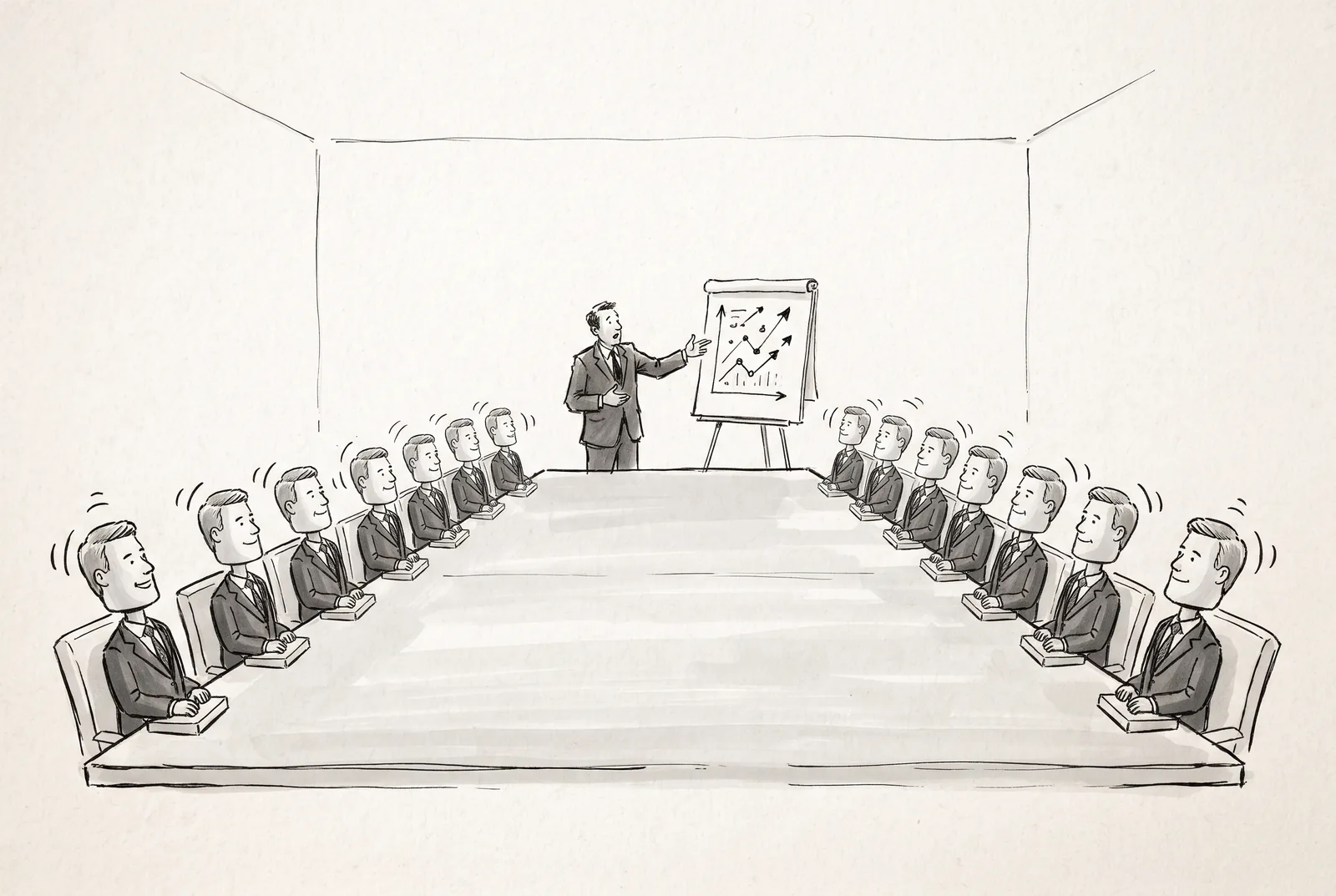
You pitch the plan to your team, your executive leadership or your board. A few heads nod. Others glance around the room. Then everyone claps, and no one questions the direction, the decisions, the ROI or the impact. The meeting ends early and you walk out sure of yourself.
That feeling is the warning sign. When nobody disagrees, it rarely means you're right. It usually means the truth has become too expensive to say. The fix isn't hiring contrarians. It's making no as cheap to say as yes.
What happens when nobody tells the boss no?
The bad news stops traveling up. Timo Vuori and Quy Huy ran 76 interviews to learn how Nokia lost the smartphone battle. Top managers were described as "extremely temperamental," and middle managers sent up filtered, optimistic updates and overpromised to win resources (INSEAD Knowledge). That fear "got in the way of transfer of information" and held back the fixes Nokia needed (Aalto University). Nokia wasn't short of smart people. It was short of people who felt safe saying what they saw.
Agreement changes the leader too. In a study of 451 CEOs, those who got more flattery saw themselves as better leaders, and their companies were less likely to change strategy when performance dipped (Park, Westphal and Stern, 2011). It makes you more certain at the exact moment you should be less.
The same pattern shows up wherever the room goes quiet:
| Case | What people knew | What the decision makers got | Source |
|---|---|---|---|
| Nokia smartphones | Problems the top didn't want to hear | Filtered, optimistic updates | INSEAD Knowledge |
| Challenger, 1986 | Thiokol engineers would not recommend a launch below 53°F | Thiokol management reversed and recommended the launch over its engineers' objections | Rogers Commission |
| Columbia, 2003 | A NASA engineer drafted an email calling his managers' decision wrong and close to irresponsible | Nothing. "My finger hovered over the send key." | PBS NOVA |
| Bay of Pigs, 1961 | Several advisers had serious doubts | "No one voted no" | Peter Wyden, via UNC |
Why don't people speak up?
Because silence feels safer. In interviews with 40 working professionals, 85% said they had at least once felt unable to raise an issue they thought was important. The top reasons were fear of being seen as a troublemaker (30%), fear of damaging a relationship (27.5%) and a sense that speaking up wouldn't change anything (25%) (Milliken, Morrison and Hewlin, 2003).
In my own work, the fears sound more personal: saying the wrong thing, losing your job, being left out, and the quiet impostor voice asking who you are to question the boss. That last one shows up in the data too: 32.5% of people in the same study pointed to their own lack of experience or rank.
Every one of those is a why. Before you can change what people say in the room, you have to understand why they hold back, and that's where the Rings of Reflection start.
People read the room. If no costs more than yes, you get yes.
When I've seen this
I worked with a founder whose growth plan was built around impressing his investors. With no research into demand, market dynamics or economic indicators, he cast a grand vision: a few locations, then a region, then a national footprint. All of it rested on how one market had grown. Every office after the first struggled, and marketing took the blame. No one stood up to challenge him, and the few who did were shown the door. I walk through the same story lens by lens in Always Start At The Beginning.
A strong leader matters. You need someone who can cast the right vision and push the organization to get there. But it matters more that the leader knows the pulse of the team, and shows through action that the team's input gets heard, discussed and debated.
How do you stop surrounding yourself with yes people?
Treat agreement as a question. When his committee at General Motors agreed unanimously, Alfred Sloan postponed the decision "to give ourselves time to develop disagreement" (Peter Drucker, via Fortune).
- Ask for the failure, not the feedback. "Any concerns?" invites silence. Run a premortem: tell the team the plan has already failed and ask each person to write down why. Imagining the outcome has already happened improves people's ability to name the reasons by 30% (Gary Klein, Harvard Business Review, 2007).
- Run a SWOT where the team writes the weaknesses and threats. A SWOT (strengths, weaknesses, opportunities, threats) only works against yes people if those two boxes come from the team, written privately before anyone sees yours. Otherwise it's one more page everyone nods at. Here's how to run a SWOT that actually gets used.
- Speak last. Hold your opinion until everyone else has given theirs, so people are answering the problem, not you.
- Find real dissent instead of faking it. In Charlan Nemeth's experiments, an assigned devil's advocate sparked no more original thinking than no dissent at all, and people dug in on their first idea. Genuine dissent changed minds (Nemeth, 2001).
- Reward the first bad news. Thank the person in front of the team, then act on it. Futility is a top reason people go quiet, so prove them wrong.
- Keep one voice outside the payroll. A peer, an advisor or a coach doesn't depend on you for a raise, so they can say what your team can't.
If no one has told you no in a while, it isn't because you've been right.
Read the full article
What did the CEO flattery study find?
Sun Hyun Park, James Westphal and Ithai Stern surveyed CEOs of US public companies and more than 3,000 of their directors and top managers between 2001 and 2007, ending with 451 CEOs in the performance analysis. CEOs who received more flattery and agreement were more likely to believe they were better leaders and better at strategy, which their companies' results did not bear out. The authors note that confidence alone didn't hurt performance. The damage came when results were weak and the flattered CEO didn't change course (Kellogg Insight).
What is groupthink?
Groupthink is what happens when keeping the peace matters more to a close team than getting the decision right. Psychologist Irving Janis described it in 1972 as a way of thinking in which the drive for agreement inside a close group overrides a realistic look at the alternatives. The Bay of Pigs was one of his case studies. Three of his warning signs map straight onto yes people: keeping doubts to yourself, assuming silence means agreement, and people who shield the leader from bad news (Simply Psychology).
What did Alfred Sloan mean by developing disagreement?
Peter Drucker tells the story in Management: Tasks, Responsibilities, Practices. At a meeting of one of GM's top committees, Sloan asked whether everyone was in complete agreement on the decision. Everyone nodded. He proposed postponing the discussion to the next meeting, so the group would have time to develop disagreement and understand what the decision was really about (Fortune). The point: if no one can name the downside, no one has understood the decision yet.
Why doesn't a devil's advocate work?
Because everyone knows it's an act. Nemeth and colleagues compared three groups: one with a genuine dissenter, one with an assigned devil's advocate and one with no dissent. Only genuine dissent increased original thinking, got people to weigh the other side and changed minds. The devil's advocate group came up with more arguments for the view it already held (Nemeth, Connell, Rogers and Brown, 2001). Nemeth's own summary: "A challenge to the majority position actually liberates people" (Behavioral Scientist).
What did the space shuttle investigations find?
The Rogers Commission found a serious flaw in the decision making process behind the Challenger launch. Thiokol's engineers would not recommend launching below 53°F, the coldest temperature in their launch data. Engineer Roger Boisjoly testified that a senior vice president asked the engineering manager to "take off his engineering hat and put on his management hat." Thiokol management then recommended the launch against its engineers' views, to accommodate a major customer (Rogers Commission report). Seventeen years later, during Columbia's flight, NASA engineer Rodney Rocha wrote an email objecting to his managers' decision and never sent it. He said protocol meant raising it through his managers instead (PBS NOVA).
Is this only a big company problem?
No, and in my view small businesses may be more exposed. In a 20 person company the owner often signs the paychecks, hired half the team personally and sits in most of the meetings. That's a lot of reasons to nod. The studies above cover large organizations, but the mechanism, people depending on the person they would have to disagree with, is the same at any size.
FAQ
What is a yes man?
Someone who agrees with the person in charge regardless of what they really think, usually to stay safe or win favor. Most aren't dishonest. They've learned that agreeing is safer.
Why do leaders end up surrounded by yes people?
Rarely on purpose. Each dismissed objection teaches the room that no costs more than yes. In one study of employee silence, the most common reasons were fear of looking like a troublemaker, fear of damaging a relationship and a sense that speaking up wouldn't change anything.
What are the signs you're surrounded by yes people?
In my experience: meetings with no pushback, bad news that reaches you late or secondhand, updates that stay green until they suddenly turn red, and the same few voices agreeing first.
Should I appoint a devil's advocate?
It's a weak substitute. In Nemeth's experiments an assigned devil's advocate did no better than no dissent at producing original ideas, and people dug in on their first view. Look for the person who genuinely disagrees, and protect them.
How can a business owner get honest feedback?
Ask specific questions, such as what would make this plan fail. Speak last, act visibly on what you hear, and keep at least one advisor who doesn't depend on you for a paycheck. Hiring helps too: hire for fit, not loyalty, because fit is what lets someone tell you the truth from day one.
- INSEAD Knowledge, Who Killed Nokia? Nokia Did
- Aalto University, Nokia analysis in Administrative Science Quarterly (2015)
- Kellogg Insight, Flattery's Dark Side (Park, Westphal and Stern, Administrative Science Quarterly, 2011)
- Report of the Presidential Commission on the Space Shuttle Challenger Accident, Chapter V
- PBS NOVA, The Insider Who Knew
- UNC School of Government, Bay of Pigs case (citing Peter Wyden, Bay of Pigs: The Untold Story)
- Milliken, Morrison and Hewlin, An Exploratory Study of Employee Silence, Journal of Management Studies (2003), via the Psych Safety Field Guide
- Fortune, Alfred P. Sloan on decision making (2015), quoting Peter Drucker
- Gary Klein, Performing a Project Premortem, Harvard Business Review (2007)
- Nemeth, Connell, Rogers and Brown, Improving Decision Making by Means of Dissent, Journal of Applied Social Psychology (2001)
- Behavioral Scientist, Stop Playing Devil's Advocate (2018)
- Simply Psychology, Groupthink (summarizing Irving Janis, 1972)